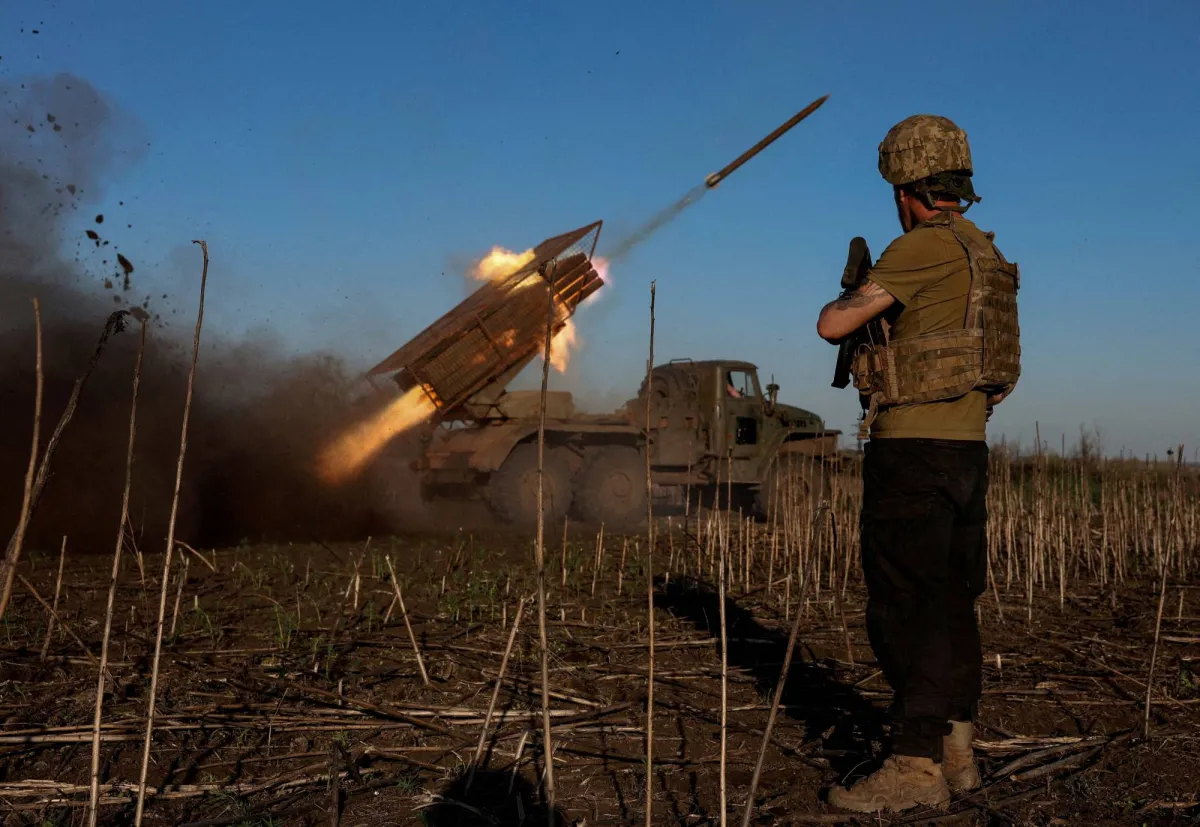
Strategic analysts unite the description of the current stage that Europe passes through “arthritis”; Due to the challenges it faces, it is known: the Ukraine war that has been continuing three and a half years ago, the wars of the Middle East and its repercussions on the ancient continent, the “comprehensive south” rebellion and its leaders seek to make a change in the balance of power in the world. However, the remarkable aspect is more than others is “fog” in relations … or what can be called “disappearance” against American policy since President Donald Trump returns to the White House at the beginning of this year.
What raises the concerns of the Europeans currently three things: The first, the military context in Europe and the fear of Europeans from Russia and its ambitions, and considering them that President Vladimir Putin “will not be satisfied” with what he will eventually get from Ukraine and that his European ambitions go further than that; Therefore, they must prepare.
The second is the fluctuation of the American administration’s policy towards the Ukraine war, and its fear that Washington will see its view of what is happening in eastern Europe; To focus its attention on China, which it considers its strategic competitor.
And the third, that the American president decide, at one moment, that defending Europe is the responsibility of the Europeans, and thus … he abandoned NATO (NATO) and withdraws the American nuclear umbrella from them, which is the umbrella that has fulfilled its shadow for decades. Which makes them reveal before what they consider a “Russian danger”. Hence, they are now finding a “alternative”.
The “alternative” umbrella can only be searched for the two nuclear states in Europe, namely France and Britain. Hence, the visit of the state by French President Emmanuel Macron to Britain, and the focus on its part on military cooperation between the two parties, specifically nuclear, may constitute an important turning point and a first step towards establishing a European nuclear deterrent. However, achieving a project like this without many obstacles, the most important of which are: European divisions, and many countries in eastern Europe and its north adhere to the American protection that provided to the ancient continent, since the founding of “NATO”, security and peace.
The British -French “Northwood Declaration”
The joint declaration entitled “The French Republic and the United Kingdom’s declaration of Great Britain and Northern Ireland on politics and cooperation in the nuclear field” is the cornerstone of strengthening defense relations between the two parties. It was stated in his first paragraph, that “there is no stronger evidence of the strength and importance of our bilateral relationship with our desire to cooperate in this extremely sensitive field.”
However, the most important thing was mentioned in the second and third paragraphs; The second came in the following: “Our nuclear weapons aim to deter the maximum threats to our two countries and our vital interests. Our nuclear forces are independent, but they are coordinated, and contribute greatly to the comprehensive security of the coalition, peace and stability in the European Atlantic region. The third paragraph stipulated that “as we declare explicitly since 1995, we do not imagine a situation in which the vital interests of one of our two countries, France and the United Kingdom, without the vital interests of the other are also threatened. And (today) France and the United Kingdom agree that there is no serious threat against Europe that does not require a response (in response) by our two countries together.
The “initial” advertisement includes a qualitative shift in terms of threats that justify the two countries ’resort to the use of nuclear weapons. The former nuclear doctrine linking the two countries dates back to 1995, which is included in the so -called “Checker Declaration”, which limits pressure on the nuclear button to mutual defense between Paris and London. According to the Northwood Declaration, the nuclear of the two countries go further. Because it indicates the possibility of resorting to the nuclear deterrence force in the event of “the existence of maximum threats for Europe.”
Because the two parties consider that “strategic ambiguity” is one of the deterrent papers, they refrain from defining the nature of “maximum threats” that call for a nuclear response. Likewise, the “declaration” does not disclose the identity of the countries concerned with this response: Does all countries belonging to the European Union (NATO) include that of the countries that are “Western” in the political concept?
As for the way to work with the new “nuclear doctrine”, it passes by “deepening cooperation and nuclear coordination” between the two parties by “establishing a French -British nuclear orientation group to ensure the political coordination of this work, and it will be managed by the presidency of the French Republic and the British Prime Minister’s office, and will play a coordination role in the strategic, capabilities and operational fields.”
At the joint press conference held by Macron with British Prime Minister Kiir Starmer on the evening of the tenth of July (July), the first stressed that “time has changed” and that military cooperation between Britain and France should take into account “confronting a major conflict in Europe during the coming years in which developed countries participate”, in reference to Russia.
Paris, as stated in the “Strategic Threats” document, which was published on July 14th, tends to consider that a conflict of this kind could happen before the reach of 2030. The French President’s summary is that “in this context, Europe must know that it can rely on a nuclear strategic pole that brings together France and the United Kingdom.”
Macron described the decisions made as “fundamental”. It is noteworthy that, in his reference to the joint “response” of the “serious threat” of Europe, he did not rule out the use of nuclear weapons by saying: “Whatever the nature of this response.” And because he is aware that the opposition is in his country, right and left; It can take it over his negligence in French sovereignty and the strength of deterrence it possesses, as he was keen, as every time this issue is raised, to confirm that France and Britain “will keep two independent and sovereign countries.”
The first French -British standpoint, that pressure on the nuclear button must remain “sovereign”, meaning that it remains in the hands of the relevant authorities in the two countries. Helwaiz Fayy, a researcher at the French Institute for International Relations, described that what was achieved in Britain is “an additional additional step with an unprecedented degree of military and political coordination”, considering that “it is consistent with the French nuclear doctrine, which considers that French vital interests includes a European dimension.”
Likewise, it believes that it is in line with the British doctrine that “traditionally falls within the framework of NATO and cooperation with the United States.” In any case, Macron called, since 2020, to launch a “strategic dialogue on the role of French nuclear deterrence in preserving our collective security,” adding that “French interests have a European dimension.” Before Macron, all French presidents touched on the “European dimension” of the French nuclear deterrence.
One umbrella or two American and European umbrellas?
On the other hand, in an article published by the newspaper “Le Monde” on March 10, under the title: “Is it time to spread a real European nuclear umbrella over Europe?”
The first scenario, called the “additional guarantee”, which assumes the survival of the American nuclear umbrella, and that the Europeans rely on France and Britain to develop a “resorental” nuclear umbrella, which is intended to provide more reassurance to the Europeans, but without interruption of the American ally what might also mean the anticipation of an American withdrawal that may happen in the future and prepare for this possibility. It is known that the United States has been deploying nuclear weapons in Germany, Belgium, Italy, the Netherlands and Turkey in the context of the so -called “nuclear weapons sharing”. However, the key to use is in Washington and can only be accessed by obtaining an American green light.
As for the other scenario, it was called “the main guarantee.” It relates to the decline of the American umbrella, and the ultimate need of Europeans to coordinate with each other to consider how to benefit from the French and British nuclear capabilities and secure a self -reliable nuclear deterrent paper “in the eyes of Moscow”.
The fact of the matter is that the European “umbrella” will not see the light tomorrow, and what was stated in the British -French declaration is only a step in the course of a thousand miles. Rather, if it is true that the French nuclear doctrine referred from before Macron to the “European dimension” of the capabilities of French deterrence, then this remained merely a construction formula that is frequent in data and speeches, without serious content.
However, Friedrich Mertz’s arrival at the Chancellor in Berlin accelerated the research in this field. Since before he officially received his tasks on May 6, Mertz has proposed the problem of the European “umbrella”, expressing his “openness” to expand the French -British nuclear protection area. “We must simply become stronger together in the field of nuclear deterrence in Europe,” Mertz said in a press interview with “Deutsche Land Fonk” radio broadcast on March 6. As the global situation, especially the current security issues, requires us Europeans to discuss this issue together, “stressing that the discussions must include France and Britain.
Macron believes that “time has changed” and that military cooperation between Britain and France must be calculated for a major conflict in Europe in a few years.
According to the new German advisor, the purpose of discussions is to “know whether Germany is able to benefit from nuclear participation (with Paris and London) or at least to obtain nuclear security.” However, he was keen to confirm two things: The first is that the European umbrella “must be complementary to the American nuclear umbrella that we of course want to keep.” The other is that Germany “will not be able and will not be allowed to possess nuclear weapons.” As a reminder, Germany signed a nuclear weapon prevention treaty. But with Trump’s return to the White House, there are voices from within the Mearsz (Christian Democratic Union) and from the extreme right (Alternative to Germany) that already calls for Germany a nuclear weapon.

German controversy
However, attention to European shadow is not stopped at the German border. Poland, in turn, is very interested. Its president André Doda said, in a statement to the French news channel “LCI”, on March 6, that his country “welcomes” that the French nuclear umbrella extend to protect European partners, adding that “the French vital interests begin in Poland, and it extends to Ukraine.” In his view, Paris’s openness, in this context, “reflects a sense of responsibility” towards protecting Europe from an external attack. However, the debate fever and his assets in Germany with the words of Yans Sebhan, the head of the Christian Democratic Representatives Group in the Bundestag, which sparked widespread controversy by saying to the newspaper “Welt Umm Santong” on July 1: “We must discuss the issue of finding an independent European nuclear umbrella, and this will only succeed with German leadership.” “If we are not able to provide a nuclear deterrent, we will turn a pawn in global politics.” And its conclusion, that Germany should “discuss its participation and the participation of Europe in the nuclear arsenal of France and Britain. Although this will be costly, to protect us, we must finance it. ”
The response came quickly from Mertz, shortly after that; “Every effort is possible to maintain the nuclear participation of the United States in the years, but in the coming decades,” said the latter during a press conference in Berlin, with Luke Frieden, Prime Minister of Luxembourg. For more clarification; He added that the purpose “is not the replacement of the guarantees provided by the United States with guarantees to Europe … and there are no concrete initiatives, but rather what is available some discussions with the French side.”
Followers realize that the nuclear issue is extremely allergic in Germany, which under the treaty called “2 Zaid 4” signed in Moscow, in December 1990, on the production, possession, or control of nuclear, chemical or biological weapons. The signed countries were: West and Eastern Germany, in addition to the four ally countries Britain, France, the United States and the Soviet Union (before its collapse). This was the price that the Germans paid to accept their country’s reunification. However, the approaching Russian danger and lack of confidence in the permanence of American protection pushes the Germans to reconsider their military and strategic situation and make them search for the “alternative” while announcing their adherence to American protection. The essence of what Mertz says about the need for the American commitment to remain European “years and decades” is serious question marks about the establishment of a European nuclear umbrella. There are questions arising from the adequacy of the French -British nuclear power, which does not exceed 525 nuclear heads to form an effective deterrent force and to protect Europe or some of it.
Moreover, the British power is organically and industrially linked to the United States. Thus, London does not have complete freedom to act with what you have. Moreover, the establishment of a European force assumes the launch of complex and difficult discussions coupled with European internal divisions between those who promote strategic independence and those who adhere to the American cilia. Accordingly, the script is likely to search for a French -British nuclear umbrella, not an actual “alternative” to the American umbrella.