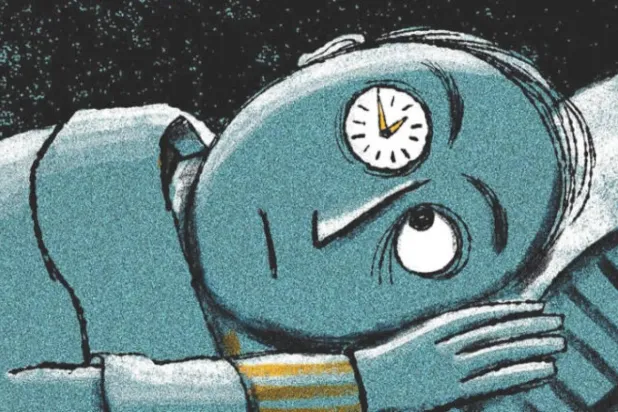
Experts agree that sleeping for seven to nine hours is the best for most adults, but when it comes to your health, the total number of hours may not be the most important factor.
In a major new study conducted by teams from Beijing University and the University of Military Medicine, irregular sleep was associated with an increase in the risk of 172 different illnesses, according to Fox News.
The researchers analyzed nearly seven years of sleep data from the British Biological Bank of 8,8461 adults at an average age of 62 years, with a focus on multiple features that included night sleep, sleep starting, sleeping, and dispersion.
Then they compared these data to the results of diseases from the National Health Services Authority, the Cancer Registry, and the National Mortality Index.
They found that for 92 disease, including Parkinson’s disease and acute kidney failure, 20 percent of the risks were linked to poor sleep misconduct.
There was an association between at least 42 illnesses with weak risk. These factors included a weakness associated with age, gangrene, and cirrhosis.
The traits of lack of sleep were associated with the risk of 122 patients with 1.5 times, including type 2 diabetes, respiratory failure, some bone fractures, and urine incontinence.
An inflammatory paths are found as one of the possible links between irregular sleep and diseases.
The researchers wrote: “Some common diseases showed great relative risks, such as Parkinson’s disease, pulmonary heart disease, type 2 diabetes, obesity, hyperthyroidism, and urine incontinence,” the researchers wrote.
“Our results emphasize the neglected importance of sleeping regularity,” Professor Singening Wang, the chief author of the study, said in a press release. It is time to expand our definition of good sleep beyond its mere duration. ”
Dr. Ashley Cortis, who holds a doctorate degree, and auxiliary professor and director of the Laboratory of Cognition, Agency, Sleep and Health (CASH) at the Faculty of Nursing at the University of South Florida, did not participate in the research, but she expressed her opinion on the results.
She explained in an interview with Fox News: “This study contributes to enhancing the increasing evidence that supports the decisive role that sleep plays as an adjustable main dangerous factor in a group of medical disorders, especially in the middle and end of life.”
She added, “Nevertheless, this study also stresses the importance of how we measure sleep in terms of the conclusions we find about its effect on health over the course of life.”
Courtis highlighted the difference between self -informed sleep patterns and objective measurements captured by wearable devices.
“It is important to better understand these patterns, because it can affect the recommendations related to aspects of sleep that must be closely monitored to assess the risk of health deterioration in the future.”
She pointed out that “in addition, these results provide an insight into the specific physiological mechanisms related to sleep that may cause paths of accompanying diseases.”
Are the restrictions noticed by the researchers?
The researchers noticed several major restrictions in this research. The most prominent of which is the failure of the study to the country’s population, as most of the middle -aged participants or the elderly were more likely to develop certain diseases.
Sleep data was also collected at only one time point.
They pointed to the possibility of the effect of external factors or “reverse causation” on the results.
Cortis confirmed these restrictions, noting that sleep is measured for only one period of seven days, and the variation of sleep patterns was not observed over time.
She added, “Moreover, sleep disturbances were not taken into account, such as insomnia or sleep apnea.”
“Due to the spread of these two disorders significantly in the elderly, future studies are needed that include a more comprehensive clinical assessment in order to clarify the relationship between patterns of sleep disorders and the risk of other accompanying diseases completely.”
The research team plans to conduct future studies to confirm the causal relationship and measure the impact of sleep interventions on the results of chronic diseases.
This study was supported by the main national program for research and development in China, the National Corporation for Natural Sciences in China, and the Health Development Research Fund.