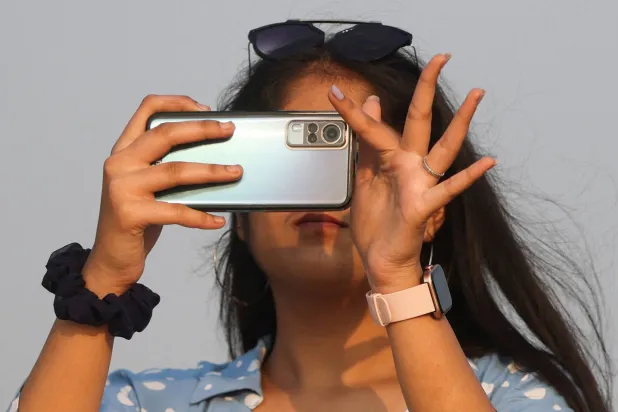
Whether it is a student attending virtual lessons, a housewife watching videos, or a store owner organizing bills on the screen, life today is about electronic devices. But although these devices facilitated our work, they also calmly affect our skin in ways that most people are unaware.
Dr. Sidhan Mahajan, a consultant dermatologist, says that the light emitted from the screens, known as blue light, can harm the skin just like strong sunlight. In fact, it can penetrate the skin deeper than the UV rays of the sun.
He explains that blue light harms the internal layers of the skin by breaking collagen and elastin, which are the protein that maintain the skin and health of the skin. As a result, the skin begins to show signs of premature aging, such as fine lines, fading and dark spots.
Many believe that staying at home protects their skin from damage. But this is no longer true. Blue light is also known as high -energy visible light (HeV), and is found in sunlight. But today, most of our exposure comes from phones, tablets, laptops, and even LED lights in our homes.
The problem is not only the presence of blue light; Rather, in the amount of time we spend with these devices and the nearby distance we use.
According to Dr. Mahjan, people spend between 6 and 10 hours a day in front of the screens, and this continuous exposure to it now shows harmful effects on their skin.
It indicates that many of his patients complain of faded and tired skin, or dark spots that do not disappear. They are often surprised when they know that the time to use screens may be the reason.
According to research, people with dark skin are more likely to be pigmentation caused by blue light.
Skin protection reserves
Dr. Mahajan suggests taking simple precautions to protect the skin. It is recommended to use phones and laptops in night mode to reduce blue light, and to use good skin care products that contain ingredients such as iron oxide, vitamin C, or niacinamide. And most importantly, the use of sunscreen even while staying at home.
It also recommends taking regular rest periods from the screen, and looking away from time to time, to allow their eyes and skin to relax.