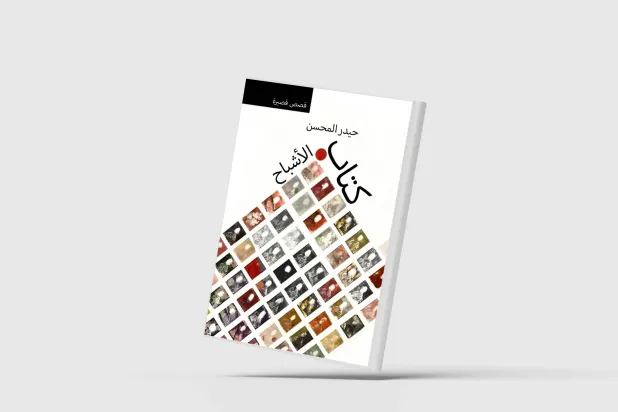
In his presentation of his anecdotal collection, “The Book of Ghosts” – the House of Training, Damascus – the Iraqi storyteller Haider Al -Mohsen justifies the conversion of his stories to the past instead of continuing to write about the present living in Iraq, (as he did in his four anecdotal collections that were issued during the last two decades) as follows: the desire to communicate with the ancestors is caused by the fact that “the future is no longer – for those who live in these countries, I mean to my country Magnet and attractive »(p. 8).
To present another argument for his decision to go towards the distant past, the writer Haider al -Mohsen was martyred by what the French novelist Flaubert (who died in 1880) said about the reason for writing the novel “Salambo”: “Few are the ones who will discover to what extent one should be sad in order to incur the trouble of reviving Carthage.”
Al -Mohsen quotes another paragraph from Flaubert to support his choice of the field in which the events of his stories take place: “Since the stories should be in the past, then the more the past is the better.”
Although I do not find any justification for any storyteller to provide any justification for his virtual reader about the reason for choosing the time of his texts, whether in the distant past, present, or distant future; The important thing is for the writer to provide us with enjoyable works, and we see the amount of effort in its lines.
And if we apply this principle, I can say that the writer Haider Al -Mohsen succeeded in presenting an elaborate collection of workmanship, and perhaps the only exception in the stories included in the book “Ghosts” the first story: “Baz”, which seemed to me a light guest more than the other ten stories.
Decoration
Perhaps what distinguishes this anecdotal group in the first place is the sovereignty of the narrator’s voice in narrating all the stories except for one story, and therefore the recipient cannot hear any internal voice for its characters, except what is rare, as if here we are following the narration of a cinematic camera for short films, as is the case with the cinema in which the events lead in time to the future we find the stories of this group enjoy the same feature Back to know the characters wallpapers. They are here at this moment, and we must accept them as they are.
To achieve this goal, the benefactive writer sought to decorate the scene in his beacon with many materials in which the vocabulary of decorations, kitchen, flowers, architecture, plants, weapons … and others will enter, and all these elements will create a great visual enjoyment if the real camera replaces the pen. This great effort exerted in rebuilding the place where historical events occurred, whether real or imagined, gives the recipient if he reads them or listens to it, the ability to imagine them as if he was watching short films that combine common themes.
Let’s take examples of three stories for that. In the story of “Harb”, which takes place during the dying of “Agha”, one of the leaders of Sultan Abdul Hamid, in the presence of the doctor who was called for his treatment: “The doctor paid attention for the first time to the doors of the high and wide hall, and to the luxurious furnished carpets, curtains, pillows and diwaniyyat spoiled with a golden gym, and to rotations, curves, yellow and purple flowers, which are smoothly occupied on the load of the Aga.” (P. 17).
In another paragraph, we follow the camera (the narrator) in his lavish description of the place where the doctor entered: With Arabic inscriptions. ”
In the story of “Theater”, we find that the decoration of the place takes the character of miniatures when the narrator’s eye describes the clothes of the princess traveling with her slaves, her servants and her soldiers at the moment the convoy stands at night on the road connected to “Al -Zubair”, and the mahoub reader may need words to search for the meanings of some of the terms of ornamental materials: Purple velor inlaid the pearl beads … but what does the servant understand about the fragrance of aloe, violet, rand and amber … »(pp. 40-41).
In another story entitled “The Game of Kings”, the narrator describes a meal that the castle commander prepares for his guests, so foods that fit with the rank of the host and the chief guest enter, and in this story only Haider Al -Mohsen used the conscience of the speaker instead of the conscience of the absent, but that did not change anything from approaching the work of the cinematic camera that provides us with a luxurious table with the most delicious foods and the most important: We were silent while we were eating, and this is evidence of the quality of the stuffed geese, the shoulder of the calf rooted with pistachios, raisins, cardamom, and stained and fried gazelle slices. As for the turkey, it was cooked with meat sauce that I did not like in my life … »(p. 63).
The present and the past
Al -Mohsen concludes in his forefront that the choice of the French novelist Flaubert Carthage, which was destroyed by the Romanian Republic in 146 BC, came because “the writing of this novel … a fictional cover for a personal subject in the life of the writer.” (P. 6).
Perhaps we find in many of the stories of this group the repetition of the theme of indiscriminate killing, as if the parish in some way is projects for pre -emptive predecessors, even if they are overwhelmed.
In the story of “Harb”, the doctor did not make any mistake when he was called to treat one of the elders of the Ottoman Empire, to find the latter in the death stage. And if his death comes the categorical ruling on the tongue of the chief blind family family: “Why did you kill the Aga? Who prompted you to do so?
Perhaps this threat has the right to some Iraqi doctors after dissolving the state and its institutions at the hands of the American civil ruler Paul Bremer after the occupation of Iraq in 2003 and the rise of the clan’s authority.
This killing is repeated in another story (it may be historically real), but it has turned here with the camel’s camel, Haider Al -Mohsen, into a three -dimensional movie and on the full screen and colors. The story bears the title: “The Story of the Architect is with the Shah.” This Persian Emperor is called “Seifi” after a dinner party organized by foreign ambassadors to celebrate the 30 -day hunt in one day.
The meat of these wild animals was part of the luxurious dinner it organized for its guests. It was a coincidence that the architect “Salahi” attended during the ceremony, so that the Shah preached his success in building a pyramid with the heads of the thirty in the city center, and everything that he needs now is one deel head to put it at the top of this pyramid in order to complete the monument.
But the king, without any reason, except that he followed a whims that jumped to his mind, orders the beheading of the architect’s head is my sacrifice to fill the remaining void of the pyramid, so the matter is implemented in a hurry.
We are following what is going on today.
In his introduction, Haider Al -Mohsen explains to the reader the reason for his choice of the title of the book “Ghosts”: “Because all the characters have left us for a long time, and they appear to the reader between the pages in a ghost body, and the highest of what the writer aspires to is to do the magic of art to do it, and the ghosts appear, then it is true like the people who live between us, and perhaps they have a stronger impact in our lives.”
It has been agreed that there is magic for art in this anecdotal collection, but is it necessary to confiscate the reader’s right to interpret the title as it pleases?